What Does Cisco Tac Use for File Uploads
Product and feature back up
Supported products
VCS/Expressway
Log file format
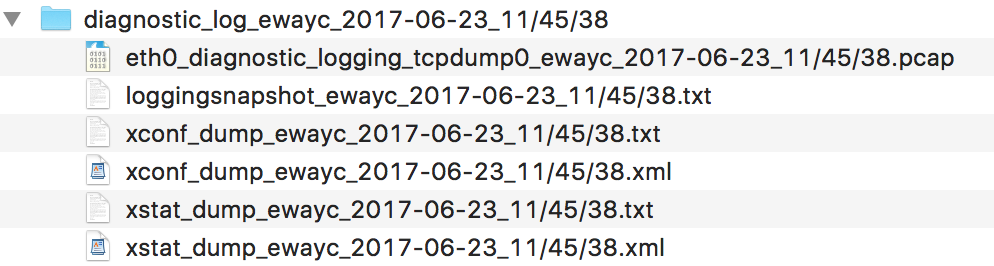
Upload the full diagnostic annal collected under Maintenance -> Diagnostics -> Diagnostic logging. Check the "take tcpdump while logging" option on the web interface to as well include pcap for extended feature set of the tool. We rely on xconf and xstat (txt and xml) files to get general arrangement information, only also some vital information required for successful chief log analysis (loggingsnapshot file). Nosotros await i annal per server.
Note: Default logs levels are fine for nearly of the analysis. Additional XMPP advice tin exist displayed with Mobile and Remote Admission login message menstruation when "developer.xcp.jabber" is prepare to DEBUG under Maintenance -> Diagnostics -> Avant-garde -> Back up Log configuration.
Supported features
- SIP/H.323 calls
- RTP streams (pcap)
- SIP registrations
- MRA sessions
- DNS
- XMPP
- STUN
- TCP/UDP streams (pcap)
CUCM (Cisco Unified Communications Manager)
Log file format
Please make sure that the information is correctly prepared as per the following guidelines:
- Utilise RTMT (Real-time monitoring tool) to download the Cisco CallManager service traces from ALL nodes in the cluster.
- Traces should be set to detailed which is the default setting from CUCM ix.X unless configured otherwise.
- Nil all the files and folders that RTMT created in i annal and upload to the tool.
- Leave original filenames(SDL*/calllogs*) and structure of directories created by RTMT.
- If in that location are multiple clusters, upload i archive per cluster.
- When troubleshooting CTI-related problems, the CTI Manager traces should be collected together with the CCM traces.
For more information almost setting the traces to "detailed" level and collecting them delight refer to this certificate.
Supported features/scenarios
- Call flows with different signalling protocols (H323/SIP/MGCP/SCCP/CTI)
- Call features: Transfer/Forrard, Hold, Recording(Gateway-recording, BIB recording)
- Media resource allocation(MTP/Xcoder,etc.)
- Mobility(SNR)
Note
Other call scenarios/features should work equally well merely are field of study to the continuous testing.
Analysis
Due to the nature and size of CCM/CTI SDL traces, the data filtering is required and the full analysis is applied on per call basis only. Several steps are executed during the analysis flow:
- Extract the archive and map SDL*/calllogs* for the same host
- Observe calls that are within SDL timelines based on SDLs/calllogs(UCM calls overview).
- After selecting the telephone call(manual pace), filter merely relevant lines
- Utilise annotations, ladder diagram based on the filtered data
- Allow ability to download the filtered data(which includes related raw SDL files).
Notation
Please note that the UCM calls overview page may not provide full information most a call, for case Disconnect reason, CI B, Telephone call-Id can be missing or multiple entries can be present. After selecting the call, all call legs should exist linked and complete information is available in Phone call Details
TC/CE endpoints
Log file format
Upload log annal collected over spider web interface under Diagnostics -> Log Files. For more information about collecting the logs please refer to this certificate.
Supported features
- SIP calls
- DNS
- SIP registration
- HTTP
CMS (Meeting server)
Log file format
Upload logbundle.tar.gz file collected over SFTP from your CMS server. Alternatively, upload log archive collected using the CMS log collector tool found hither.
Supported features
- SIP calls
Jabber customer
Log file format
Upload the problem report (PRT) generated by the Jabber client. All jabber platforms are supported from version 11.vi.
Supported features
- SIP calls and registration
- DNS requests
- HTTP requests
Jabber version CLI script
Currently there is no pick in IM&P server user interface to list versions of Jabber clients logged into IM&P server at any requite time. This tool uses data dump from server CLI to generate the report.
Log file format
In that location are 2 txt files required, each of which has the following format:
- line 1: CLI query
- line 2+: the output of CLI query
and contains one of the two queries:
- run sql select pkid ,userid from enduser (ran on CUCM)
- run pe sql ttlogin select * from clientsessions (ran on IM&P)
Example file content
query ane
admin:run sql select pkid ,userid from enduser pkid userid ==================================== =============================================== ae003243-0632-4b79-a042-dcbc82b68485 vsidimak@cisco.com query 2
admin:run pe sql ttlogin select * from clientsessions sqlRv(t) sqlstmt(select * from clientsessions;) ***result set start*** "count(1), success(t)" <msg><type>TTLOGIN</blazon><tabular array>clientsessions</table><action>Q</action><time>0</time><old><ane>4f40c76b-148d-47cc-a7d4-5d18a83c479c</1><5>one</v><6>11.8.4.52954</half-dozen><two>5e029d96-bb8d-8983-5af4-b6d70db3fd33</ii><four>null</4><3>4adc1203-0eca-14cd-b5b8-3a78f76cbce6</three><0>00000001:59a31f79:000095bf:00000006</0></old></msg> Usage tips
- Since the output of queries might exist large, brand sure you increment the 'Lines of scroll back' nether 'Window' section in Putty.
- Run the query on each node in the IM&P cluster and copy the output into separate files. You will take to run the tool for each IM&P individually, or alternatively merge the outputs from different servers for the same query into ane file, post-obit the format above.
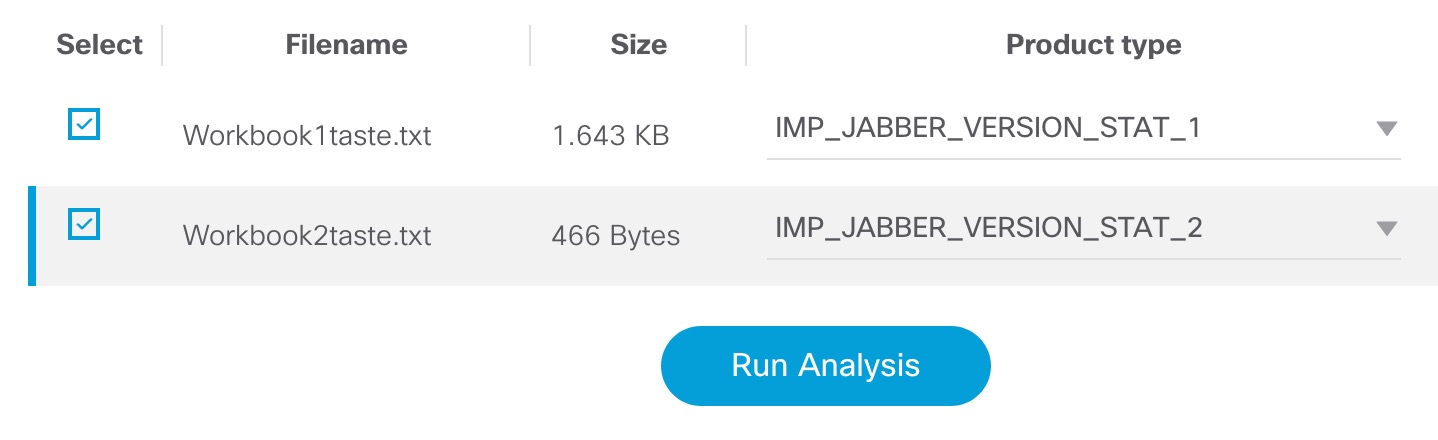
- Upload the files to the tool, which will automatically detect the product types as IMP_JABBER_VERSION_STAT_1 (query ane) and IMP_JABBER_VERSION_STAT_2 (query 2) respectively.
- Select both files and hit "Run analysis".
Annotation: The CLI outputs only provide Real-time Jabber statistics and not historical.
Sample tool output

Conductor
Log file format Upload the full diagnostic archive collected under Maintenance -> Diagnostics -> Diagnostic logging. Check the "have tcpdump while logging" pick on the web interface to also include pcap for extended feature set of the tool. We rely on xconf and xstat (txt and xml) files to get general system information, merely too some vital information required for successful main log analysis (loggingsnapshot file).
Supported features
- SIP calls
- Conferences
- RTP streams (pcap)
- TCP/UDP streams (pcap)
- DNS (pcap)
- API/HTTP
CVP (Customer Voice Portal)
Log file format
Upload the CVP Phone call Server logs nerveless from location C:\Cisco\CVP\logs. The log file names should not be changed. In order analyze SIP calls from CVP, SipLibrary logging should be enabled on CVP CS server. Please refer to this educational activity.
Supported features
- SIP calls
- GED-125 (communication between CVP and ICM)
PerfMon for Vox Operating System
Log file format
Upload the archive that contains perfmon logs(Cisco RIS Data Collector PerfMonLog) collected using the RTMT tool from your Voice Operating System (CUCM,CUC,UCCX, etc.) server. The log bundle should contain PerfMon_*.csv files which record performance counters like CPUTime, VmSize(Virtual Retention Size), etc. This tool visualizes specific counters allowing you to easily spot bug.
Supported features
Before analysis, you will need to select i of the available templates:
- Operation preview template (CPU, retentiveness, IOWait)
- Disk/storage troubleshooting template
- CPU template
- CUCM call activity template
- DB replication
Source: https://cway.cisco.com/docs/tools/CollaborationSolutionsAnalyzer/csa.callengine.supportedproducts.html
0 Response to "What Does Cisco Tac Use for File Uploads"
Post a Comment