How Can Teachers Help Families Understand and Embrace Cultural Identities
viii.1 Foundations of Civilisation and Identity
Learning Objectives
- Define culture.
- Define personal, social, and cultural identities.
- Summarize nondominant and dominant identity development.
- Explain why difference matters in the study of culture and identity.
Culture is a complicated word to define, every bit there are at least six common ways that culture is used in the United States. For the purposes of exploring the communicative aspects of culture, we volition ascertain civilisation as the ongoing negotiation of learned and patterned behavior, attitudes, values, and behaviors. Unpacking the definition, we tin see that culture shouldn't be conceptualized as stable and unchanging. Culture is "negotiated," and as we will acquire later in this affiliate, culture is dynamic, and cultural changes can be traced and analyzed to better understand why our society is the fashion it is. The definition also points out that civilisation is learned, which accounts for the importance of socializing institutions like family, schoolhouse, peers, and the media. Culture is patterned in that in that location are recognizable widespread similarities among people within a cultural group. There is also deviation from and resistance to those patterns past individuals and subgroups within a culture, which is why cultural patterns change over time. Last, the definition acknowledges that culture influences our beliefs about what is true and simulated, our attitudes including our likes and dislikes, our values regarding what is right and wrong, and our behaviors. It is from these cultural influences that our identities are formed.
Personal, Social, and Cultural Identities
Ask yourself the question "Who am I?" Recall from our earlier discussion of self-concept that we develop a sense of who we are based on what is reflected back on us from other people. Our parents, friends, teachers, and the media help shape our identities. While this happens from nativity, nearly people in Western societies reach a stage in boyhood where maturing cognitive abilities and increased social awareness lead them to begin to reflect on who they are. This begins a lifelong process of thinking most who we are now, who we were before, and who we volition become (Tatum, B. D., 2000). Our identities make up an important part of our self-concept and can be broken down into three main categories: personal, social, and cultural identities (see Table 8.1 "Personal, Social, and Cultural Identities").
Nosotros must avert the temptation to think of our identities equally constant. Instead, our identities are formed through processes that started before we were born and volition go along afterwards we are gone; therefore our identities aren't something nosotros achieve or complete. Two related only distinct components of our identities are our personal and social identities (Spreckels, J. & Kotthoff, H., 2009). Personal identities include the components of cocky that are primarily intrapersonal and connected to our life experiences. For example, I consider myself a puzzle lover, and you may identify equally a fan of hip-hop music. Our social identities are the components of self that are derived from interest in social groups with which we are interpersonally committed.
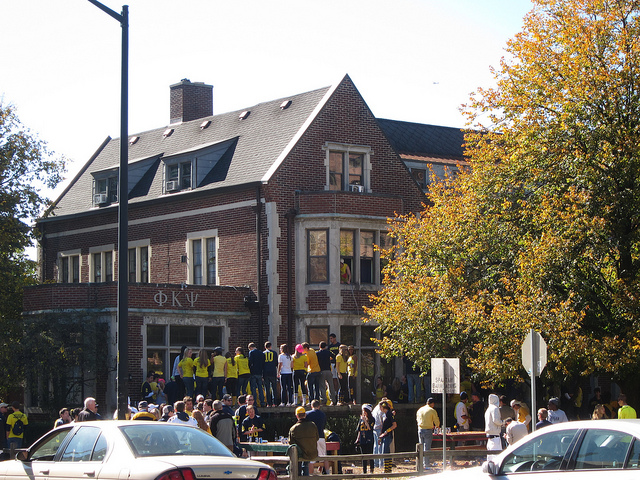
Pledging a fraternity or sorority is an example of a social identity.
For instance, we may derive aspects of our social identity from our family or from a community of fans for a sports team. Social identities differ from personal identities because they are externally organized through membership. Our membership may be voluntary (Greek organisation on campus) or involuntary (family) and explicit (we pay dues to our labor union) or implicit (nosotros purchase and listen to hip-hop music). In that location are innumerous options for personal and social identities. While our personal identity choices express who we are, our social identities marshal united states of america with item groups. Through our social identities, we make statements about who we are and who we are not.
Table 8.one Personal, Social, and Cultural Identities
| Personal | Social | Cultural |
|---|---|---|
| Antique Collector | Member of Historical Society | Irish gaelic American |
| Dog Lover | Member of Humane Society | Male/Female |
| Cyclist | Fraternity/Sorority Fellow member | Greek American |
| Singer | Loftier Schoolhouse Music Teacher | Multiracial |
| Shy | Book Lodge Fellow member | Heterosexual |
| Athletic | Gay/Lesbian |
Personal identities may alter often as people have new experiences and develop new interests and hobbies. A electric current interest in online video games may give style to an interest in graphic design. Social identities do not change as ofttimes because they have more time to develop, as you must become interpersonally invested. For example, if an interest in online video games leads someone to become a member of a MMORPG, or a massively multiplayer online office-playing game customs, that personal identity has led to a social identity that is at present interpersonal and more entrenched. Cultural identities are based on socially constructed categories that teach u.s.a. a way of existence and include expectations for social behavior or ways of acting (Yep, G. A., 2002). Since we are oftentimes a part of them since birth, cultural identities are the least changeable of the three. The ways of being and the social expectations for behavior within cultural identities exercise change over time, merely what separates them from virtually social identities is their historical roots (Collier, M. J., 1996). For example, think of how means of being and acting take inverse for African Americans since the civil rights movement. Additionally, common means of being and acting within a cultural identity group are expressed through advice. In society to exist accepted every bit a member of a cultural group, members must be acculturated, essentially learning and using a lawmaking that other grouping members volition exist able to recognize. We are acculturated into our various cultural identities in obvious and less obvious ways. We may literally have a parent or friend tell us what it ways to be a man or a adult female. We may as well unconsciously swallow letters from pop culture that offer representations of gender.
Any of these identity types can be ascribed or avowed. Ascribed identities are personal, social, or cultural identities that are placed on us past others, while avowed identities are those that we claim for ourselves (Martin & Nakayama, 2010). Sometimes people ascribe an identity to someone else based on stereotypes. You may see a person who likes to read scientific discipline-fiction books, watches documentaries, has glasses, and collects Star Expedition memorabilia and characterization him or her a nerd. If the person doesn't avow that identity, it can create friction, and that label may even hurt the other person'south feelings. But ascribed and avowed identities can match up. To extend the previous instance, there has been a motion in contempo years to reclaim the characterization nerd and turn information technology into a positive, and a nerd subculture has been growing in popularity. For example, MC Frontalot, a leader in the nerdcore hip-hop movement, says that existence branded a nerd in schoolhouse was terrible, but now he raps about "nerdy" things like blogs to sold-out crowds (Shipman, 2007). We can run into from this instance that our ascribed and avowed identities change over the class of our lives, and sometimes they friction match upward and sometimes not.
Although some identities are essentially permanent, the degree to which nosotros are aware of them, also known as salience, changes. The intensity with which we avow an identity also changes based on context. For example, an African American may not take difficulty deciding which box to cheque on the demographic section of a survey. Merely if an African American becomes president of her college's Black Pupil Union, she may more intensely avow her African American identity, which has at present go more salient. If she studies away in Africa her junior year, she may exist ascribed an identity of American by her new African friends rather than African American. For the Africans, their visitor's identity as American is likely more salient than her identity as someone of African descent. If someone is biracial or multiracial, they may change their racial identification as they engage in an identity search. One intercultural communication scholar writes of his experiences equally an "Asianlatinoamerican" (Yes, 2002). He notes repressing his Chinese identity as an adolescent living in Peru and then later embracing his Chinese identity and learning about his family history while in higher in the U.s.a.. This example shows how even national identity fluctuates. Obviously one can change nationality past condign a citizen of another country, although virtually people do non. My identity equally a US American became very salient for me for the first time in my life when I studied abroad in Sweden.
Throughout modern history, cultural and social influences have established dominant and nondominant groups (Allen, 2011). Ascendant identities historically had and currently take more resources and influence, while nondominant identities historically had and currently have less resources and influence. It's important to remember that these distinctions are existence made at the societal level, not the individual level. In that location are obviously exceptions, with people in groups considered nondominant obtaining more resource and ability than a person in a ascendant group. However, the overall tendency is that difference based on cultural groups has been institutionalized, and exceptions do not change this fact. Considering of this uneven distribution of resources and power, members of dominant groups are granted privileges while nondominant groups are at a disadvantage. The main nondominant groups must face various forms of institutionalized bigotry, including racism, sexism, heterosexism, and ableism. As nosotros will discuss later, privilege and disadvantage, like similarity and divergence, are not "all or nil." No two people are completely different or completely similar, and no ane person is completely privileged or completely disadvantaged.
Identity Development
There are multiple models for examining identity development. Given our focus on how difference matters, we will examine similarities and differences in nondominant and dominant identity germination. While the stages in this model assist us understand how many people experience their identities, identity evolution is circuitous, and there may be variations. We must also remember that people take multiple identities that intersect with each other. So, as you read, think well-nigh how circumstances may be different for an private with multiple nondominant and/or dominant identities.
Nondominant Identity Development
There are four stages of nondominant identity development (Martin & Nakayama, 2010). The first stage is unexamined identity, which is characterized past a lack of awareness of or lack of involvement in one's identity. For example, a young woman who will afterwards identify as a lesbian may not all the same realize that a nondominant sexual orientation is part of her identity. Also, a young African American man may question his teachers or parents virtually the value of what he'due south learning during Blackness History Month. When a person's lack of interest in their own identity is replaced past an investment in a dominant group'due south identity, they may move to the next stage, which is conformity.
In the conformity stage, an individual internalizes or adopts the values and norms of the dominant grouping, often in an endeavour not to be perceived every bit different. Individuals may effort to assimilate into the dominant culture by changing their appearance, their mannerisms, the fashion they talk, or even their name. Moises, a Chicano man interviewed in a enquiry project about identities, narrated how he changed his "Mexican sounding" proper noun to Moses, which was easier for his middle-schoolhouse classmates and teachers to say (Jones Jr., 2009). He as well identified every bit white instead of Mexican American or Chicano because he saw how his teachers treated the other kids with "brown skin." Additionally, some gay or lesbian people in this stage of identity evolution may effort to "act straight." In either case, some people move to the adjacent stage, resistance and separation, when they realize that despite their efforts they are still perceived every bit dissimilar by and not included in the ascendant group.
In the resistance and separation phase, an private with a nondominant identity may shift away from the conformity of the previous stage to engage in deportment that challenge the dominant identity group. Individuals in this stage may besides actively try to separate themselves from the ascendant group, interacting only with those who share their nondominant identity. For example, there has been a Deaf culture motion in the United States for decades. This movement includes people who are hearing impaired and believe that their use of a specific linguistic communication, American Sign Language (ASL), and other cultural practices constitutes a unique culture, which they symbolize by capitalizing the D in Deafened (Allen, 2011).
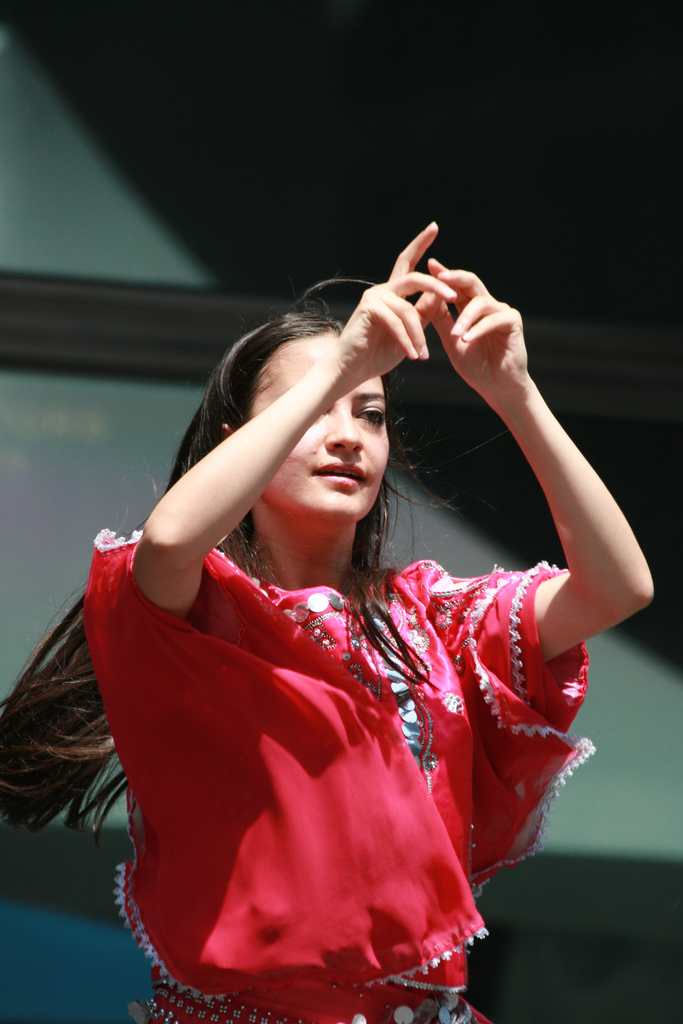
Many hearing-impaired people in the United States utilise American Sign Language (ASL), which is recognized as an official language.
While this is not a separatist movement, a person who is hearing impaired may find refuge in such a grouping later experiencing discrimination from hearing people. Staying in this phase may bespeak a lack of disquisitional thinking if a person endorses the values of the nondominant grouping without question.
The integration stage marks a period where individuals with a nondominant identity have achieved a residuum betwixt embracing their own identities and valuing other dominant and nondominant identities. Although in that location may still exist remainder acrimony from the discrimination and prejudice they take faced, they may direct this energy into positive outlets such every bit working to finish bigotry for their own or other groups. Moises, the Chicano man I mentioned earlier, at present works to support the Chicano community in his city and likewise has actively supported gay rights and women's rights.
Dominant Identity Development
Ascendant identity evolution consists of five stages (Martin & Nakayama, 2010). The unexamined phase of dominant identity germination is similar to nondominant in that individuals in this stage do non remember about their or others' identities. Although they may exist aware of differences—for example, between races and genders—they either don't realize at that place is a hierarchy that treats some people differently than others or they don't think the hierarchy applies to them. For example, a white person may have find that a person of color was elected to a prominent office. All the same, he or she may not see the underlying reason that information technology is noticeable—namely, that the overwhelming majority of our state'south leaders are white. Unlike people with a nondominant identity who ordinarily accept to admit the positioning of their identity due to discrimination and prejudice they run into, people with dominant identities may stay in the unexamined stage for a long time.
In the acceptance stage, a person with a ascendant identity passively or actively accepts that some people are treated differently than others only doesn't practise anything internally or externally to address it. In the passive acceptance stage, we must be cautious not to blame individuals with dominant identities for internalizing racist, sexist, or heterosexist "norms." The socializing institutions nosotros discussed before (family unit, peers, media, religion, and education) often make oppression seem normal and natural. For instance, I have had students who struggle to encounter that they are in this phase say things like "I know that racism exists, but my parents taught me to be a good person and see everyone as equal." While this is beauteous, seeing everyone every bit equal doesn't brand information technology so. And people who insist that we are all equal may claim that minorities are exaggerating their circumstances or "whining" and just need to "work harder" or "go over it." The person making these statements acknowledges difference but doesn't come across their privilege or the institutional perpetuation of various "-isms." Although I've encountered many more people in the passive land of acceptance than the agile state, some may progress to an active state where they admit inequality and are proud to be in the "superior" group. In either example, many people never progress from this stage. If they do, information technology's usually because of repeated encounters with individuals or situations that challenge their credence of the status quo, such as befriending someone from a nondominant grouping or taking a course related to civilisation.
The resistance stage of dominant identity formation is a major alter from the previous in that an individual acknowledges the unearned advantages they are given and feels guilt or shame virtually it. Having taught nigh various types of privilege for years, I've encountered many students who desire to render their privilege or disown it. These individuals may brainstorm to disassociate with their own dominant group because they feel like a curtain has been opened and their awareness of the inequality makes it hard for them to collaborate with others in their dominant group. But it's important to admit that becoming aware of your white privilege, for instance, doesn't mean that every person of color is going to want to accept you as an ally, and so retreating to them may non exist the well-nigh productive move. While moving to this pace is a marked improvement in regards to becoming a more than aware and socially just person, getting stuck in the resistance phase isn't productive, because people are often retreating rather than trying to address injustice. For some, deciding to share what they've learned with others who share their dominant identity moves them to the adjacent stage.
People in the redefinition stage revise negative views of their identity held in the previous stage and brainstorm to acknowledge their privilege and try to apply the power they are granted to piece of work for social justice. They realize that they can claim their dominant identity as heterosexual, athletic, male person, white, and so on, and perform their identity in means that counter norms. A male participant in a research projection on identity said the following nearly redefining his male identity:
I don't desire to assert my maleness the same manner that maleness is asserted all around u.s. all the time. I don't want to contribute to sexism. So I have to exist conscious of that. There'southward that guilt. Simply so, I try to utilize my maleness in positive ways, like when I'1000 talking to other men most male person privilege (Jones, Jr., 2009).
The terminal stage of dominant identity formation is integration. This stage is reached when redefinition is consummate and people can integrate their ascendant identity into all aspects of their life, finding opportunities to educate others nearly privilege while also being a responsive ally to people in nondominant identities. Equally an instance, some heterosexual people who find out a friend or family unit member is gay or lesbian may take to confront their ascendant heterosexual identity for the commencement fourth dimension, which may lead them through these various stages. As a sign of integration, some may join an organization like PFLAG (Parents, Families, and Friends of Lesbians and Gays), where they tin be around others who share their ascendant identity as heterosexuals but likewise empathize with their loved ones.
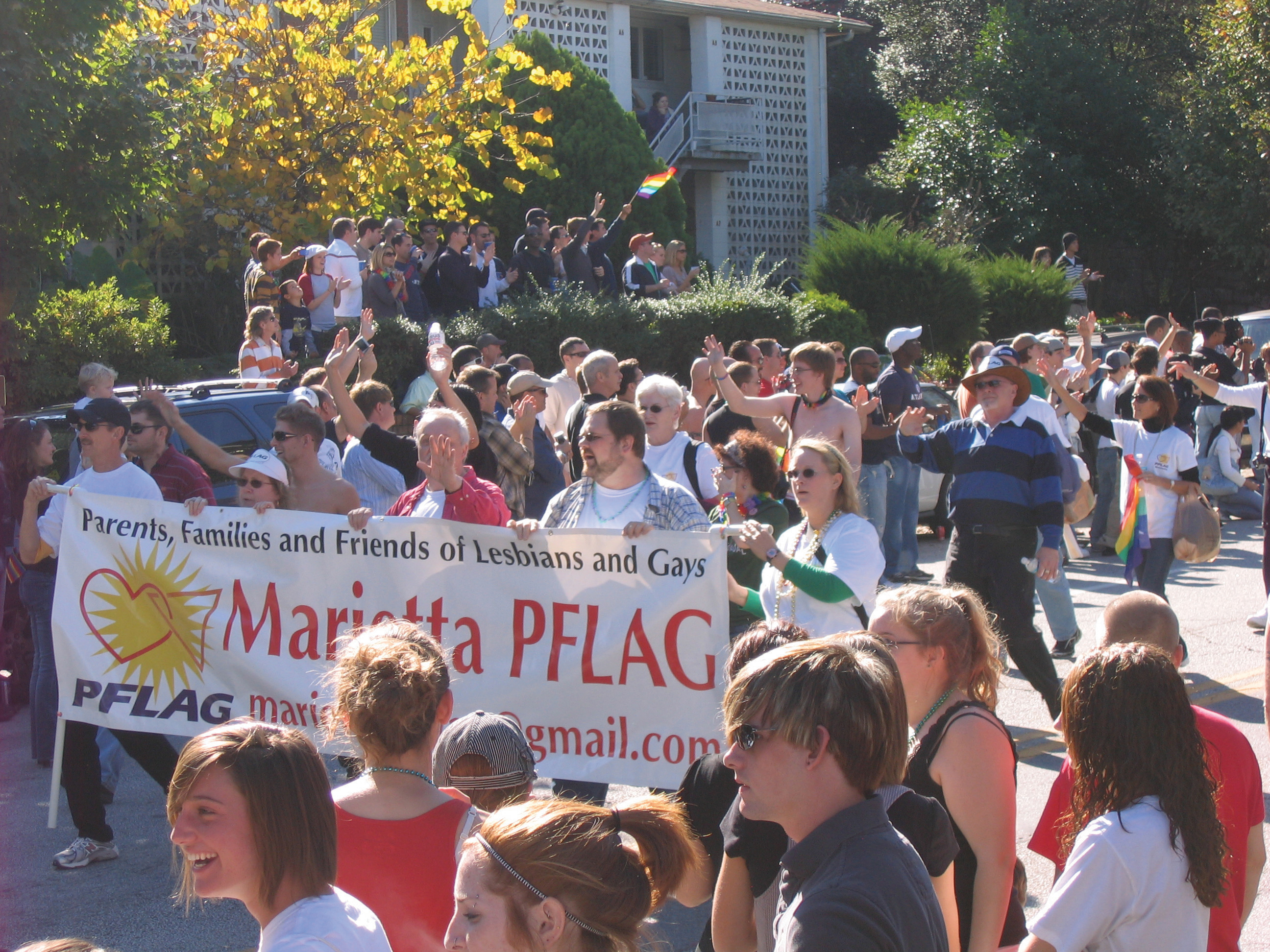
Heterosexual people with gay family unit members or friends may bring together the group PFLAG (Parents, Families, and Friends of Lesbians and Gays) as a part of the redefinition and/or integration phase of their dominant identity evolution.
Knowing more about various types of identities and some common experiences of how ascendant and nondominant identities are formed prepares united states of america to delve into more than specifics most why deviation matters.
Deviation Matters
Whenever we encounter someone, nosotros observe similarities and differences. While both are important, it is ofttimes the differences that are highlighted and that contribute to communication troubles. We don't only run into similarities and differences on an private level. In fact, we likewise place people into in-groups and out-groups based on the similarities and differences nosotros perceive. This is important because nosotros and then tend to react to someone we perceive as a member of an out-group based on the characteristics we adhere to the group rather than the individual (Allen, 2011). In these situations, it is more likely that stereotypes and prejudice will influence our communication. Learning about difference and why it matters volition help us exist more competent communicators. The flip side of emphasizing difference is to claim that no differences exist and that you see everyone every bit a human. Rather than trying to ignore difference and see each person as a unique private, we should know the history of how differences came to exist and so socially and culturally significant and how they continue to affect united states of america today.
Culture and identity are complex. You lot may be wondering how some groups came to be dominant and others nondominant. These differences are not natural, which can be seen as we unpack how diverse identities take changed over time in the next section. There is, however, an ideology of domination that makes it seem natural and normal to many that some people or groups volition always have ability over others (Allen, 2011). In fact, hierarchy and domination, although prevalent throughout mod human history, were likely non the norm among early humans. So one of the starting time reasons divergence matters is that people and groups are treated unequally, and better agreement how those differences came to be tin can assistance u.s.a. create a more just society. Deviation also matters because demographics and patterns of interaction are irresolute.
In the United States, the population of people of color is increasing and diversifying, and visibility for people who are gay or lesbian and people with disabilities has also increased. The 2010 Census shows that the Hispanic and Latino/a populations in the United states are at present the second largest group in the country, having grown 43 percent since the last census in 2000 (Saenz, 2011). By 2030, racial and ethnic minorities will account for one-third of the population (Allen, 2011). Additionally, legal and social changes have created a more open environs for sexual minorities and people with disabilities. These changes directly affect our interpersonal relationships. The workplace is 1 context where changing demographics has get increasingly of import. Many organizations are striving to comply with changing laws by implementing policies aimed at creating equal access and opportunity. Some organizations are going further than legal compliance to try to create inclusive climates where diversity is valued because of the interpersonal and economic benefits it has the potential to produce.
"Getting Real"
Diversity Training
Businesses in the U.s.a. spend $200 to $300 million a twelvemonth on diversity training, but is it effective? (Vedantam, 2008) If diverseness grooming is conducted to advance a company'due south business goals and out of an understanding of the advantages that a diverseness of background and thought offering a company, then the training is more likely to be successful. Many companies conduct mandatory diversity grooming based on a belief that they will be in a better position in court if a lawsuit is brought against them. However, research shows that preparation that is mandatory and undertaken simply to brainwash people most the legal implications of variety is ineffective and may even hurt multifariousness efforts. A commitment to a various and inclusive workplace environment must include a multipronged approach. Experts recommend that a visitor put a staff person in charge of multifariousness efforts, and some businesses have gone equally far as appointing a "chief diversity officer" (Cullen, 2007). The US Office of Personnel Management offers many good guidelines for conducting diversity preparation: create learning objectives related to the mission of the organization, utilise tested and advisable preparation methods and materials, provide information about course content and expectations to employees ahead of training, provide the training in a supportive and noncoercive environment, utilise but experienced and qualified instructors, and monitor/evaluate training and revise every bit needed (Usa Office of Personnel Management, 2011). With these suggestions in mind, the increasingly common "real-world" event of diverseness training is more likely to succeed.
- Have you ever participated in any diversity training? If so, what did y'all learn or take away from the training? Which of the guidelines listed did your training do well or poorly on?
- Practice you think variety training should be mandatory or voluntary? Why?
- From what you've learned so far in this volume, what communication skills are of import for a variety trainer to have?
We can now run across that difference matters due to the inequalities that exist amongst cultural groups and due to changing demographics that bear upon our personal and social relationships. Unfortunately, there are many obstacles that may impede our valuing of difference (Allen, 2011). Individuals with ascendant identities may non validate the experiences of those in nondominant groups because they exercise not experience the oppression directed at those with nondominant identities. Further, they may find it difficult to acknowledge that not being aware of this oppression is due to privilege associated with their ascendant identities. Considering of this lack of recognition of oppression, members of dominant groups may minimize, dismiss, or question the experiences of nondominant groups and view them every bit "complainers" or "whiners." Remember from our earlier discussion of identity formation that people with dominant identities may stay in the unexamined or credence stages for a long time. Existence stuck in these stages makes information technology much more difficult to value divergence.
Members of nondominant groups may have difficulty valuing difference due to negative experiences with the dominant group, such as not having their experiences validated. Both groups may be restrained from communicating about departure due to norms of political definiteness, which may make people feel agape to speak upwardly considering they may be perceived equally insensitive or racist. All these obstacles are mutual and they are valid. Even so, as we will learn afterwards, developing intercultural communication competence can help us gain new perspectives, become more mindful of our communication, and intervene in some of these negative cycles.
Key Takeaways
- Culture is an ongoing negotiation of learned patterns of beliefs, attitudes, values, and behaviors.
-
Each of u.s.a. has personal, social, and cultural identities.
- Personal identities are components of self that are primarily intrapersonal and connect to our individual interests and life experiences.
- Social identities are components of self that are derived from our involvement in social groups to which we are interpersonally invested.
- Cultural identities are components of cocky based on socially constructed categories that teach usa a way of being and include expectations for our thoughts and behaviors.
- Nondominant identity formation may include a person moving from unawareness of the importance of their identities, to adopting the values of dominant gild, to separating from dominant social club, to integrating components of identities.
- Dominant identity formation may include a person moving from unawareness of their identities, to accepting the identity hierarchy, to separation from and guilt regarding the dominant group, to redefining and integrating components of identities.
- Difference matters because people are treated differently based on their identities and demographics and patterns of interaction are irresolute. Knowing why and how this came to be and how to navigate our increasingly diverse society can make us more than competent communicators.
Exercises
- List some of your personal, social, and cultural identities. Are there whatever that relate? If so, how? For your cultural identities, which ones are dominant and which ones are nondominant? What would a person who looked at this listing be able to tell nigh you?
- Describe a situation in which someone ascribed an identity to you that didn't match with your avowed identities. Why do you lot think the person ascribed the identity to you? Were at that place whatever stereotypes involved?
- Getting integrated: Review the department that explains why difference matters. Discuss the ways in which divergence may influence how you communicate in each of the following contexts: academic, professional, and personal.
References
Allen, B. J., Difference Matters: Communicating Social Identity, 2d ed. (Long Grove, IL: Waveland, 2011), 4.
Collier, K. J., "Communication Competence Problematics in Ethnic Friendships," Communication Monographs 63, no. 4 (1996): 318.
Cullen, L. T., "Employee Diversity Training Doesn't Piece of work," Fourth dimension, April 26, 2007, accessed October 5, 2011, http://www.time.com/time/magazine/article/0,9171,1615183,00.html.
Jones Jr., R. M., "Communicating Queer Identities through Personal Narrative and Intersectional Reflexivity" (PhD diss., University of Denver, 2009), 130–32.
Martin, J. N., and Thomas K. Nakayama, Intercultural Communication in Contexts, 5th ed. (Boston, MA: McGraw-Hill, 2010), 166.
Saenz, A., "Census Data Shows a Inverse American Landscape," ABC News, March 21, 2011, accessed Oct 9, 2011, http://abcnews.become.com/Politics/demography-data-reveals-inverse-american-landscape/story?id=13206427.
Shipman, T., "Nerds Get Their Revenge as at Concluding It's Hip to Be Foursquare," The Sunday Telegraph, July 22, 2007, 35.
Spreckels, J. and Helga Kotthoff, "Communicating Identity in Intercultural Communication," in Handbook of Intercultural Communication, eds. Helga Kotthoff and Helen Spencer-Oatey (Berlin: Mouton de Gruyter, 2009), 415–19.
Tatum, B. D., "The Complexity of Identity: 'Who Am I?'" in Readings for Diversity and Social Justice, eds. Maurianne Adams, Warren J. Blumfeld, Rosie Casteneda, Heather W. Hackman, Madeline L. Peters, Ximena Zuniga (New York: Routledge, 2000), ix.
US Office of Personnel Management, "Guidelines for Conducting Multifariousness Grooming," Training and Evolution Policy, accessed October xvi, 2011, http://www.opm.gov/hrd/lead/policy/divers97.asp#Role%20B.
Vedantam, S., "Most Diversity Grooming Ineffective, Study Finds," The Washington Post, January 20, 2008, accessed October 5, 2011, http://world wide web.washingtonpost.com/wp-dyn/content/article/2008/01/19/AR2008011901899_pf.html.
Yep, G. A., "My Three Cultures: Navigating the Multicultural Identity Landscape," in Intercultural Communication: Experiences and Contexts, eds. Judith N. Martin, Lisa A. Flores, and Thomas Chiliad. Nakayama (Boston, MA: McGraw-Hill, 2002), 61.
Source: https://open.lib.umn.edu/communication/chapter/8-1-foundations-of-culture-and-identity/
0 Response to "How Can Teachers Help Families Understand and Embrace Cultural Identities"
Post a Comment